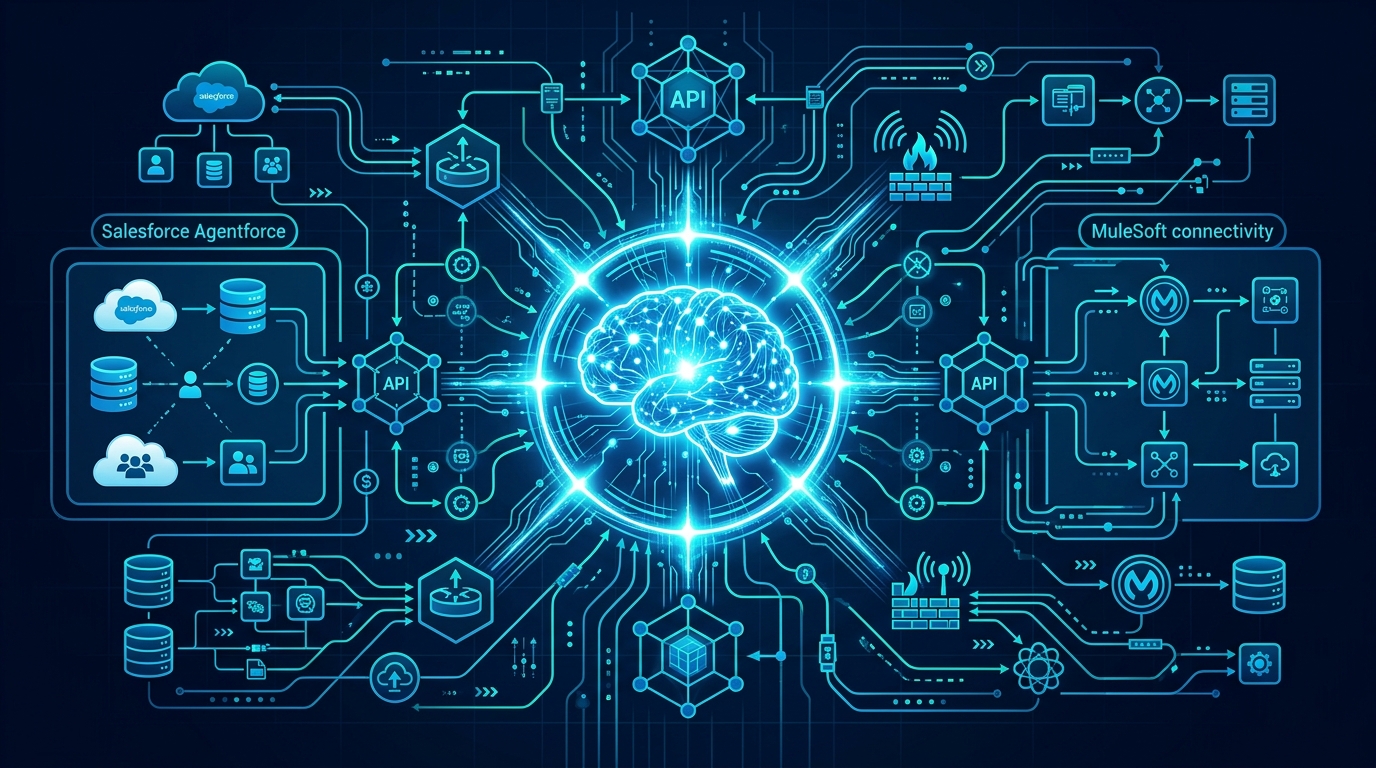
The transition from deterministic integration to AI-driven orchestration does not require abandoning your MuleSoft architecture expertise; it requires evolving it. You already own the hardest part of enterprise AI: retrieving the ground-truth data. The next step is exposing that data to non-deterministic reasoning engines.
For an architect expanding into enterprise software and training, the pivot centers on transforming standard RESTful endpoints into discoverable, governed tools for autonomous agents. Here is the curriculum to bridge your MuleSoft background with modern AI orchestration.
Phase 1: AI Agent Fundamentals & The Python Ecosystem
Before integrating MuleSoft with AI, you must understand how AI agents “think” and invoke tools. Python is the lingua franca here.
- Large Language Model (LLM) Tool Calling: Understand how models like GPT-4 or Claude translate natural language into structured JSON payloads to trigger external APIs.
- LangChain & LangGraph: Build basic agents in Python. Learn how agents use a ReAct (Reason + Act) loop to evaluate a user request, query an API, evaluate the response, and decide the next step.
- Vector Embeddings & RAG: Learn how to convert enterprise data into vector embeddings. Agents use Retrieval-Augmented Generation (RAG) to pull real-time context before taking action.
Phase 2: Mastering the Model Context Protocol (MCP)
MCP is the standardized architecture connecting AI models (like Anthropic’s Claude or Salesforce’s Agentforce) to external data sources. This is where your integration expertise shines.
- The MCP Architecture: Learn the interaction between an MCP Host (the AI platform), an MCP Client (middleware managing stateful sessions), and an MCP Server (the interface exposing your APIs).
- Stateful Agent Sessions: Unlike traditional stateless REST calls, MCP maintains context across interactions. An agent can query an ERP, receive results, and ask follow-up questions within the same session.
- Building Custom MCP Servers: Practice wrapping standard REST APIs in Python using MCP SDKs to expose them as tools to local AI agents.
Phase 3: MuleSoft Agent Fabric & Agentforce Integration
MuleSoft has heavily integrated MCP to bridge API-led connectivity with Salesforce’s AI ecosystem.
- MuleSoft MCP Bridge: Learn how to use the Anypoint Omni Gateway to expose existing APIs directly as MCP servers. This auto-generates tool definitions from your OpenAPI specs without writing custom Python wrappers.
- Salesforce Agentforce & Atlas: Understand how the Atlas Reasoning Engine dynamically discovers the tools exposed by your MuleSoft MCP Bridge and orchestrates them alongside native Salesforce actions.
- Evolving API-Led Connectivity:
- System APIs remain unchanged (unlocking core data).
- Process APIs are increasingly replaced or augmented by AI Agents orchestrating the logic dynamically.
- Experience APIs evolve into MCP Servers tailored for AI consumption, focusing on rich semantic descriptions rather than human-readable payloads.
Phase 4: AI Governance & The Einstein Trust Layer
When an AI can trigger a purchase order, security is paramount.
- Zero-Trust for Agents: Apply OAuth 2.0 and API policies specifically for autonomous systems.
- The Einstein Trust Layer: Understand how Salesforce masks PII, enforces field-level security, and maintains audit logs before data ever reaches the LLM.
- Agent Rate Limiting: Implement strict token and latency budgets at the API Gateway level to prevent runaway agent loops from overwhelming backend systems.