In enterprise architecture, the complexity of a system is rarely purely technical. The hardest systems to build and maintain are those governed by intense regulatory compliance—such as healthcare (HIPAA), financial services (PCI-DSS/SOX), or aerospace engineering.
In these environments, a single bug is not just a nuisance; it can lead to massive financial penalties, license revocation, or in safety-critical systems, the loss of human life.
To survive and thrive in these domains, generic technical architecture falls short. Instead, we must apply Domain-Driven Design (DDD) as a strategic tool to isolate compliance zones, preserve data integrity, and build resilient systems from first principles.
1. Isolating Compliance with Bounded Contexts
One of the most common mistakes in large systems is building a unified, monoline database schema that represents all aspects of the business. In a regulated environment, this is a security and compliance nightmare. If a single table containing Personal Identifiable Information (PII) is coupled to marketing, audit, and billing systems, your entire system falls under GDPR/HIPAA audit scopes.
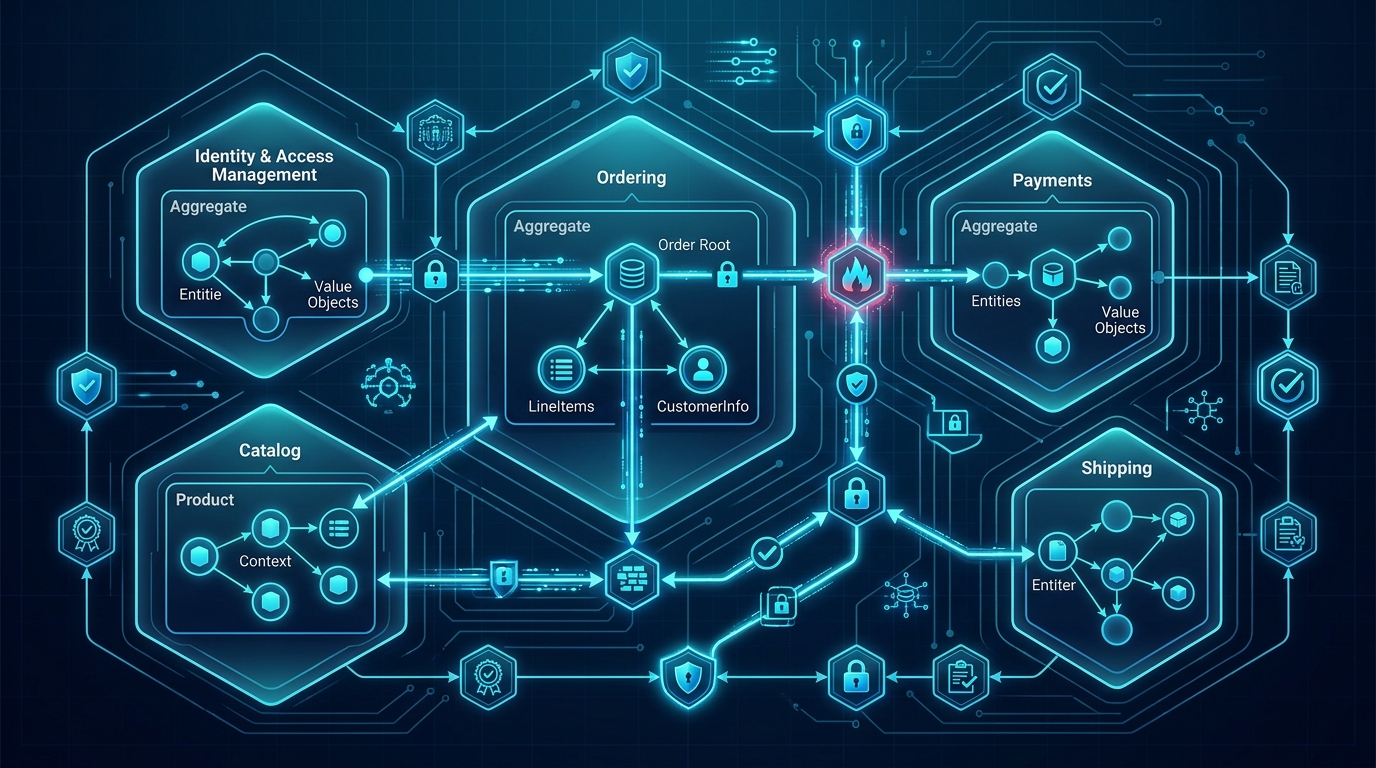
DDD solves this via Bounded Contexts. By drawing strict linguistic and conceptual boundaries around parts of the system, we can isolate compliance requirements:
- PII / Patient Records Context: Subject to strict encryption, access logs, and residency audits.
- Diagnostics Context: Focused on medical algorithms, needing high availability but no direct association with patient names.
- Billing Context: Governed by financial auditing and invoice standards.
By separating these contexts and integration paths, only a fraction of the system needs to undergo the highest compliance auditing, saving millions in compliance costs and reducing vulnerability vectors.
                  [THE ENTERPRISE LANDSCAPE]
┌───────────────────────────┐       ┌───────────────────────────┐
│   Patient Records (PII)   │       │   Billing Context (SOX)   │
│   - Strict Audit Logs     │       │   - Immutable Ledgers     │
│   - Encrypted at Rest     │       │   - Financial Compliance  │
└───────────────────────────┘       └───────────────────────────┘
              ▲                                   ▲
              └───────────────[ ACL ]─────────────┘
                     Anti-Corruption Layer
2. Enforcing Invariants via Aggregate Roots
In high-compliance systems, maintaining consistent state is non-negotiable. An aggregate is a cluster of domain objects that can be treated as a single unit. The Aggregate Root is the gatekeeper of this unit, ensuring that all business rules (invariants) are strictly satisfied before any state changes are persisted.
For example, in a financial transfer domain:
- The invariant states that an account balance cannot drop below zero during an automated transfer if it is a standard checking account.
- The Aggregate Root (
Account) encapsulates the ledger entries and ensures this rule cannot be violated, regardless of database race conditions or concurrent API requests.
AI models often generate code that bypasses aggregate roots to directly query or update child database tables for convenience. In high-stakes architecture, this bypass is a critical risk vector. A human architect ensures that all data access conforms strictly to the aggregate boundary.
3. Designing for Audits with Event Sourcing
In highly compliant domains, knowing the current state of a database is not enough. Regulators need to know how the system arrived at that state. Who authorized the change? When did the event occur? What was the prior state?
Event Sourcing fits naturally with Domain-Driven Design. Instead of overwriting database rows, we store a sequence of immutable, chronological events:
[
  { "eventId": "101", "type": "AccountOpened", "timestamp": "2026-08-25T09:00:00Z" },
  { "eventId": "102", "type": "FundsDeposited", "amount": 50000.00, "authorizedBy": "Peter" },
  { "eventId": "103", "type": "ComplianceHoldPlaced", "reason": "Large Deposit Check" }
]
These events represent facts that have occurred in the domain. They cannot be altered or deleted. A system built on Event Sourcing provides an out-of-the-box audit log that is mathematically verifiable and compliance-compliant by design.
Conclusion
Compliance is not a set of annotations to add to your code after it is built. It is a fundamental architectural constraint. By employing Domain-Driven Design, mapping bounded contexts, and modeling aggregate roots, human architects design platforms that are resilient, secure, and ready for regulatory scrutiny.